Wednesday, November 12, 2008

Guide to Pressure Cookers and Fryers(Select commercial pressure cookers and fryers to save time and money)

Custom Search
Managing a restaurant is a competitive business and having the right commercial pressure fryers and pressure cookers is an enormous factor in its success. Locating a knowledgeable pressure cooker supplier can be paramount to your restaurant's daily function. It’s imperative to figure out when the restaurant is at its busiest time, and make sure that your equipment is dependable. Selecting dependable equipment happens with the right knowledge about the product. There are many things to know when purchasing pressure cookers.

Commercial pressure cookers and fryers cook at a level that’s fast and efficient. Gas powered heats more quickly yet electric cookers are more energy efficient. Knowing your floor space is necessary when choosing between the two. Both are products that are necessary to run your restaurant efficiently due to their versatility. With either, you can cook anything from main courses to desserts. It's important to be informed and here are a few ideas to get you started:

1. Consult a pressure cooker provider to obtain suggestions for new equipment purchase.

2. Find out about wholesale restaurant pressure cookers to save on your budget.

3. Consider buying used or refurbished commercial pressure fryers to cut down on costs.
Action Steps : The best contacts and resources to help you get it done.

> Contact a pressure fryer manufacturer for a consultation on equipment.
A pressure cooker manufacturer can tell you more about purchasing the equipment that's the perfect fit for your restaurant. They can also give answers to all of the questions you may have about specific pressure cooker and fryer equipment. Calling one for a consultation is a good idea so that you have an expert opinion and can make the right choices.

> Check with wholesale vendors for a low pressure fryer.
When trying to manage a budget, wholesale vendors can offer bulk quantities, which utilize a system of selling more items at a lower price. This can make a difference in business' profit since you're considering equipment at a discount price.

> Buying used or refurbished pressure cookers saves on business expenses.
Using refurbished or used pressure cookers can help with your profit by saving on the cost of purchasing new equipment. In fact, a used commercial pressure fryer is often just as reliable as a new one, at a fraction of the cost.

Tips & Tactics.
----------------
Helpful advice for making the most of this Guide.
Always check the warranty on the pressure cookers and fryers that you are interested in purchasing. by Kimm Hill
Read more....

Electric Cookers - Cook Fast, Forget Past

Custom Search


Cookers have been used in the households for a long time. Several types of cookers are used for cooking food in the kitchen. Gas cookers, electric cooking devices and oil-filled cooking equipments are some of the popular choices for cooking. The electric cookers are not only used by the housewives but also by the professional chefs. The professional people prefer to use these equipments because they are non reactive and so they keep food hygienic.

Electric cookers are simple cooking utensils that are manufactured considering several safety measures. With the technological advancements taking place, different manufacturing companies are making programmable cookers which can be very helpful to the users. Such cookers can be adjusted for high or low pressure cooking, boiling, baking or warming the food items. The electronic thermostat is used in manufacturing the cookers which gives more strength to them.

The electric range cookers are being manufactured in many colours and designs. Several attractive features have been added in them in order to lure the customers. The push-button controls and digital display are the latest facilities provided with the electric cooking devices these days. The available designs are chrome range, chrome solid door type and many others. One can also find the manufacturers claiming that their cookers do not consume electricity at all. The users should avoid falling in such traps.
For making a smart purchase, one should take care of certain points. Users can go for the renowned brands since they provide a sort of reliability. These big names follow stringent quality policy in their organisation and therefore the probability of manufacturing faulty cookers is very less. The higher temperature resistance capability in cookers is another factor that should be considered because such products can cook food in a faster way. The nutrients of vegetables and other types of foods stay trapped in such cookers. In addition to that, multi-deck container facility is provided in some of the advanced electric range cookers so that users could cook several kinds of food at the same time.
Read more....

Tuesday, November 11, 2008

Know your pressure canner and how it works(Pressure Canner)

Custom Search
Canning meats and vegetables takes higher than boiling temperatures to kill the bacteria that cause botulism, which can be fatal. Pressure canning is the only way to reach these temperatures. Know your pressure canner and how it works. Whether you have a small-capacity pressure canner holding only 4 quarts or the largest canner, which can hold 18 pints in two layers, all are treated in the same manner and should be vented using the typical venting procedures. A loaded pressure canner requires about 12-15 minutes of heating before it begins to vent, another 10 minutes to vent the canner, another 5 minutes to pressurize the canner, another 20-90 minutes to process low acid food and finally another 20-60 minutes to cool the canner before removing jars.

Essential Parts(Pressure Canner).

Closures or covers of pressure canners lock in place so that they cannot be lifted by steam. Older canners are closed with a thumb-screw type closure.
Covers on newer canners usually have turn-on lids. Pressure gauges record the pressure. The dial or the weight with a sliding core shows the pressure within the canner, you must adjust the heat to keep the pressure steady. The weight type permits pressure to rise to a definite point and then releases excess steam by rocking or jiggling to keep pressure from going higher. Gaskets of rubber or rubberlike compounds keep steam from leaking out around the cover. Handle canner lid gaskets carefully and clean them according to the manufacturer’s directions. Nicked or dried gaskets will allow steam leaks during pressurization of canners. Keep gaskets clean between uses. Gaskets on older model canners may require a light coating of vegetable oil once a year. Gaskets on newer model canners are prelubricated and do not benefit from oiling.Check your canner’s instructions if there is doubt that the particular gasket you use has been prelubricated. Vents allow steam to escape from the canner. To vent a canner, leave the vent port uncovered on newer models or manually open petcocks on some older models. Heating the filled canner with its lid locked into place causes the water to boil and generates steam that escapes through the petcock or vent port. When steam first escapes, set a timer for 10 minutes. After venting 10 minutes, close the petcock or place the counterweight or weighted gauge over the vent port to pressurize the canner. Safety fuses are thin metal inserts or rubber plugs designed to relieve excessive pressure from the canner. Do not pick at or scratch fuses while cleaning lids. Use only canners that have the Underwriter’s Laboratory (UL) approval. Replacement gauges and other parts for canners are often available at stores offering canning equipment or from canner manufacturers. When ordering parts, give your canner model number and describe the parts needed.
Read more....

Thursday, November 6, 2008

History of the Pressure Cooker

Custom Search
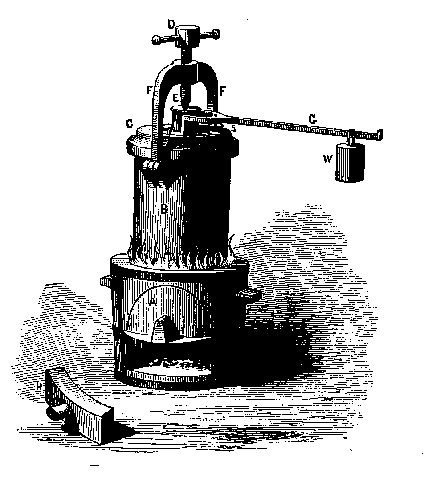
The first version of a pressure cooker was created by Denis Papin, French physicist and mathematician (1647-1712). In 1679 he made a large cast iron vessel with a tightly fitted lid that locked. His invention raised the boiling point of water and at this higher temperature, bones softened and meat cooked in quick time. He promoted it as, "A New Digester or Engine, for softaing bones, the description of its makes and use in cookery, voayages at see, confectionary, making of drinks, chemistry, and dying, etc. "The early models were cumber some and the "digester" required a specially-built furnace and it was somewhat dangerous to use. Regulating the steam and temperature was difficult to control so explosions were common. Papin then developed a safety valve his digester earned him membership in the Royal Society in 1680.
To demonstrate his invention, he cooked a meal for the Royal Society and King Charles II. Many of the aristocicy of the day were present, including the noted horticulturalist John Evelyn, who recorded in his diary:
"1682, 12th April: I went this afternoon with several of the Royal Society to a supper which was all dressed, both fish and flesh, in Monsieur Papin's digestors, by which the hardest bones of beef itself, and mutton, were made as soft as cheese, without
water or other liquor, and with less than eight ounces of coals, producing an incredible quantity of gravy; and for close of all, a jelly made of the bones of beef, the best for clearness and good relish, and the most delicious that I had ever seen, or tasted. We eat pike and other fish bones, and all without impediment; but nothing exceeded the pigeons, which tasted just as if bak’d in a pie, all these being stewed in their own juice without any addition of water save what swam about in the Digester, as in bal neo; …. I sent a glass of jelley to my wife, to the reproach of all that the ladies ever made of the best hartshorn...."

Diary and Correspondence of John Evelyn, F.R.S., published 1862.
Read more....

Sunday, November 2, 2008

How to Buy the Best Pressure Cooker?

Custom Search
People always want to know which is the 'BEST' pressure cooker. There is no easy answer because this is largely a matter of personal preference based on your needs, and your budget. Keep in mind that whatever brand of pressure cooker you buy, it should be expected to give you a lifetime of service, so shop wisely and invest in the future. Here's some practical information to help you make an informed decision on purchasing a new pressure cooker.
Let The Buyer Compare and BEWARE! When considering which pressure cooker to buy be sure to read the product information carefully and beware of catchy advertising slogans, or fancy marketing. Think twice about companies that charge outrageous amounts of money for "new products" which are nothing more than an ordinary pressure cookers. There are many heavily advertised "pressure cookers" that only cook at low pressure (Cooks Essential, T-Fal, Turbo Cooker, Prestige Cooker). There are pressure cookers cannot even reach the standard 15psi pressure. Pressure cookers that do not meet the accepted standard of 15psi means you will have to adjust pressure cooker recipes which are designed for 15psi.


Stainless Steel.
Buy a Stainless Steel model with a triple wall bottom (SS-aluminum core-SS, or copper), it will minimize burned foods, heats faster and retains heat longer, which translates to improved energy efficiency and a saves a little money on fuel bills over time.

Name Recognition.
Buy from a long established company and avoid the heavily marketed fads. You will need new seals every now and then, so you'll want a reliable company where you can still purchase replacements, parts and accessories in the future.

Remember - Do the research to locate several sources of replacement parts BEFORE buying.

Size Matters.
Buy a large size, remember you can only utilize 2/3 of the actual volume of the pot, or 1/2 in the case of cooking dried beans. Five quarts is the minimal useful size, even for singles and couples if you intend to get the most out of your cooker. The larger models also make it easier to fit inside the various accessories like pans, dishes, bowls, pots and such that will extend the usefulness of your investment. Any pressure cooker less than 5 quarts will not be big enough to cook a meal for you family, soups, dry beans, or large foods.

Handles Are Important.
Buy a cooker with a long handle and a shorter helped handle on the opposite side of the bottom unit. Unlike cookers with two short handles, the longer handles protectS your fingers from touching the hot pot, make it easier to carry a heavy pot and provides some leverage when locking the lid in place

The New, Modern Pressure Cookers.
If you are looking to buy a pressure cooker, today's second generation cooker models with their improved valve systems and multiple safety features the perfered choice. The old style 'jiggle-top' cookers are still being manufactured, but they do not compare to the improvements to be found in the new generation cookers. The modern pressure cooker easier to use, 100% safe and foolproof. They are quiet and come to pressure quicker than the old jiggle top models.

Canning is a Science.
If you enjoy canning a pressure canner is a useful investment. Canning requires updated, tested canning recipes, specialized equipment and accurate timing based on your altitude to safely process canned foods for home consumption.
Read more....

Thursday, October 30, 2008

All American Pressure Cooker(Metal to Metal System)

Custom Search

Since 1930, All American pressure cookers are manufactured by Wisconsin Aluminum Foundry. Besides cookers, they also manufacture high quality pressure canners that are used to store and preserve food. If you are already set on one of the All American cookers, then you have chosen a great product for your kitchen. The biggest advantage and one thing All American pressure cookers are known for is their sealing system. It is a so called Metal To Metal system, which uses clamping licks that align the cover to the steel container, thus making the tight seal. This is as strong as they can get. Since there is no gasket involved in this process, the cover can be easily closed and opened.
Read more....

Wednesday, October 29, 2008

Pressure Canner Drawing(Presto Pressure Canner)

Custom Search

Pressure canners for use in the home have been extensively redesigned in recent years. Models made before the 1970's were heavy-walled kettles with clamp-on or turn-on lids. They were fitted with a dial gauge, a vent port in the form of a petcock or counterweight, and a safety fuse.
Modern pressure canners are lightweight, thin-walled kettles; most have turn-on lids. They have a jar rack, gasket, dial or weighted gauge, an automatic vent/cover lock, a vent port (steam vent) to be closed with a counter weight or weighted gauge, and a safety fuse. Pressure does not destroy microorganisms, but high temperatures applied for an adequate period of time do kill microorganisms. The success of destroying all microorganisms capable of growing in canned food is based on the temperature obtained in pure steam, free of air, at sea level. At sea level, a canner operated at a gauge pressure of 10.5 lbs. provides an internal temperature of 240°F.
Read more....

Smart Pressure Canner - Smart Chef

Custom Search
Forget whatever horror stories you heard about your grandmother's pressure cooker. For time saving, flavor and nutrition no cooking method beats today's safe and reliable pressure cookers. You can get home at 7:00 and have a complete, fresh, home cooked meal on the table by 7:30 or even earlier. Put those soggy, bland microwave meals behind you, and get ready to accept the adulation of your adoring family.
Presto pressure cookers have been around for a long time and offer a variety of different sized stainless steel and aluminum pots. Professional chefs prefer a stainless pressure cooker because it is nonreactive and can be safely cleaned in a dishwasher, but aluminum is also a good choice if weight is a consideration. You want heat resistant double handles, one on each side of the pot, in every case. A 6 quart pressure cooker is minimum family size. Go larger if you will use it as a canner.

Many models come with useful accessories like racks, trivets or vegetable steamers which keep food from sticking to the bottom of the pot. Most chefs brown meats before attaching the lid so sticking does occur. You may still want to avoid nonstick interiors, however. The occasional inconvenience of a little extra cleaning far outweighs the risk of a pitted or peeling interior coating. Nonstick interiors are less of a potential problem with electric pressure cookers. Read more....

Tuesday, October 28, 2008

How To Pressure Can Food(Presto Pressure Canner)

Custom Search
Follow these step-by-step instructions for pressure canning in your presto pressure canner. Prepare food according to the directions in specific recipe.


1. The first step in pressure canning is to bring together the canning gear. Be sure your presto pressure canner is carefully cleaned and working appropriately. Before each canning season, check the dial gauge for precision. You are strongly advised to check the sealing ring, overpressure plug, and the rubber gasket of the air vent/cover lock. Replace these parts when they become hard, warped, cracked, worn, pitted, or strangely soft.

2. Check Mason jars for nicks, cracks, and sharp edges. Check screw bands for dents or rust. Use only jars, lids, and bands in perfect condition so an airtight seal may be obtained. Wash and rinse jars, lids, and bands. Pour hot water into jars and set aside until needed. Follow closure manufacturer’s directions for bands and lids.

3. Select fresh firm food. Sort food according to size. Clean food thoroughly. Prepare according to recipe. Fill hot Mason jars promptly with food and liquid to recommended level. Allow ½-inch headspace for fruits. ALL vegetables and meats require 1-inch headspace due to expansion during processing. Work out air bubbles with a clean nonmetallic spatula. Wipe sealing edge clean with a damp cloth. Adjust bands according to closure manufacturer’s directions.

4. Place 3 quarter of boiling water, canning rack, and jars in canner. To prevent water stains on jars, add 2 tablespoons white vinegar to water in canner. Always use canning rack. Jars may break if set directly on bottom of canner.

5. Look through the vent pipe to be certain it is open before placing cover on canner. To clean the vent pipe, draw a pipe cleaner or small brush through the opening

6. Place cover on canner aligning the V mark on the cover with the V mark on the body handle and lock securely by turning in the direction indicated to close (clockwise). Cover handles must be centered over body handles. Do not force beyond this position.

7. Exhaust air from the canner and jars by adjusting heat to are relatively high setting to obtain a free flow of steam from the vent pipe. Consult the instruction book which accompanied your range for recommended heat setting. Reduce heat to maintain a moderate steam flow. Allow steam to flow for 10 minutes.

8. Place pressure regulator on vent pipe. Set burner at a relatively high heat setting, on most range burners, and heat canner until pressure dial gauge registers desired pressure.

9. Processing time begins when pressure gauge registers the correct pressure. Adjust heat to maintain correct pressure on the dial gauge.

10. At end of processing time, turn burner to “OFF” and remove canner from heat source. Lift pressure canner to remove it from burner. Sliding cookware can leave scratches on stovetops.

11. Let pressure drop of its own accord, do not quick-cool. Pressure is completely reduced when the air vent/cover lock and overpressure plug have dropped and no steam escapes when the pressure regulator is tilted. Do not use the pressure dial gauge as an indicator for when pressure is completely reduced. Attempting to speed the cooling of the canner may cause jar breakage.

12. When pressure has been completely reduced, remove pressure regulator from vent pipe and let canner cool for 10 minutes. Do not remove the pressure regulator until pressure is completely reduced and the air vent/cover lock has dropped. Always remove pressure regulator before opening the cover.

13. To remove cover, turn counterclockwise until cover hits stop. Cover handles will be beyond the body handles. If cover seems to stick or is hard to turn, do not force it open. Sticking may indicate that there is still pressure inside the canner. If in doubt about pressure being completely reduced, let the canner stand until cool before removing the cover.

14. Lift canner cover toward you to keep steam away from you when opening.

15. Remove jars from canner. Set jars apart on board or cloth away from draft to cool. When jars are cold, test seal, remove bands, wipe jars, label, date, and store in a cool, dry place
Read more....

Thursday, October 9, 2008

Clever Presto Pressure Canner - Make Your Life Easier Than Ever ( Presto Pressure Canner )

Custom Search

Your presto pressure canner is a extraordinary, large capacity pressure vessel designed for home canning a wide variety of fruits, vegetables, meats, and poultry. Presto pressure canner may also be used to fast cook many of your favorite foods in larger quantities than can be prepared in a conservative size pressure cooker. The canner uses pressure to achieve the high temperatures required for safely processing foods while canning. The most wonderful thing about presto pressure canner is its capability to cook many foods in one-third to one-tenth the time required by traditional methods. Cooking in presto pressure canner preserves flavor and nutrients and softens tougher cuts of meat. .

Read more....