
Custom Search
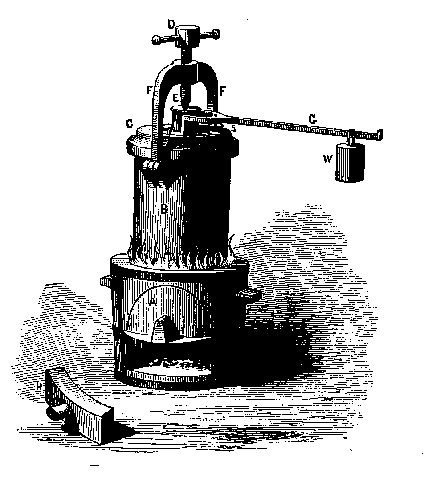
 The first version of a pressure cooker was created by Denis Papin, French physicist and mathematician (1647-1712). In 1679 he made a large cast iron vessel with a tightly fitted lid that locked. His invention raised the boiling point of water and at this higher temperature, bones softened and meat cooked in quick time. He promoted it as, "A New Digester or Engine, for softaing bones, the description of its makes and use in cookery, voayages at see, confectionary, making of drinks, chemistry, and dying, etc. "The early models were cumber some and the "digester" required a specially-built furnace and it was somewhat dangerous to use. Regulating the steam and temperature was difficult to control so explosions were common. Papin then developed a safety valve his digester earned him membership in the Royal Society in 1680.
 To demonstrate his invention, he cooked a meal for the Royal Society and King Charles II. Many of the aristocicy of the day were present, including the noted horticulturalist John Evelyn, who recorded in his diary:
"1682, 12th April: I went this afternoon with several of the Royal Society to a supper which was all dressed, both fish and flesh, in Monsieur Papin's digestors, by which the hardest bones of beef itself, and mutton, were made as soft as cheese, without water or other liquor, and with less than eight ounces of coals, producing an incredible quantity of gravy; and for close of all, a jelly made of the bones of beef, the best for clearness and good relish, and the most delicious that I had ever seen, or tasted. We eat pike and other fish bones, and all without impediment; but nothing exceeded the pigeons, which tasted just as if bak’d in a pie, all these being stewed in their own juice without any addition of water save what swam about in the Digester, as in bal neo; …. I sent a glass of jelley to my wife, to the reproach of all that the ladies ever made of the best hartshorn...."
"1682, 12th April: I went this afternoon with several of the Royal Society to a supper which was all dressed, both fish and flesh, in Monsieur Papin's digestors, by which the hardest bones of beef itself, and mutton, were made as soft as cheese, without
 water or other liquor, and with less than eight ounces of coals, producing an incredible quantity of gravy; and for close of all, a jelly made of the bones of beef, the best for clearness and good relish, and the most delicious that I had ever seen, or tasted. We eat pike and other fish bones, and all without impediment; but nothing exceeded the pigeons, which tasted just as if bak’d in a pie, all these being stewed in their own juice without any addition of water save what swam about in the Digester, as in bal neo; …. I sent a glass of jelley to my wife, to the reproach of all that the ladies ever made of the best hartshorn...."
 Diary and Correspondence of John Evelyn, F.R.S., published 1862.





No comments:
Post a Comment